AI Capstone: AI Chart Recommendation Engine
Leveraging Gen AI to help users build presentations backed by cognitive science research
Overview
Overview: Developing a 0-to-1 AI feature for an early-stage startup to drive fundraising
Role: AI Product Manager (scoping, prompt engineering, and UI prototyping)
Mission: Build a production-grade prompt and prototype that detects chart types, extracts data, and analyzes visual elements to make actionable recommendations

Challenge: Unlocking chart comprehension
The existing AI engine was limited to text analysis—it couldn't interpret or analyze charts and graphs.
Heuristics development: Translate the founder’s unstructured research-backed data/guidelines into clearly defined, actionable heuristics for accurate recommendations.
Lack of storytelling: Users received feedback on text structure, but no guidance on whether their data visualization was effective or not.
Scalability barriers: Without automated chart parsing, the platform could not provide a comprehensive AI Coach experience for decks
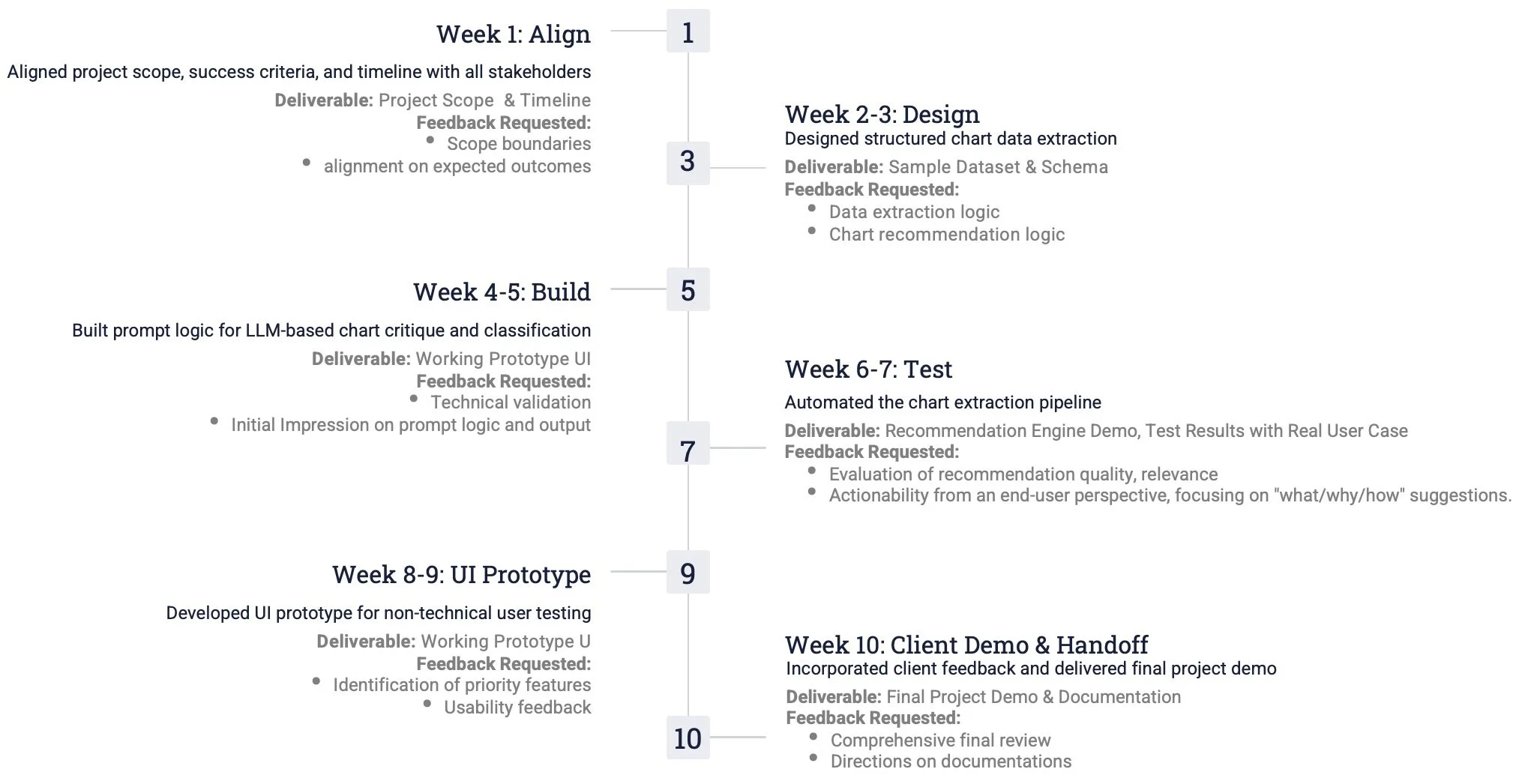
Project timeline
Solution: A multi-stage chart critique engine
Product vision: To transform raw chart images into structured data and professional design recommendations using a blend of rule-based logic and LLM reasoning.
Core value proposition:
Automated extraction: High-precision detection and classification of common chart types (bar, line, pie).
Heuristic-driven feedback: A two-stage analysis that first checks for fundamental chart choice (e.g., "Is a pie chart appropriate here?") and then evaluates design emphasis (e.g., "Should this legend be direct labels?").
Actionable coaching: Generating "What/Why/How" suggestions that tell the user exactly how to improve their visual impact.
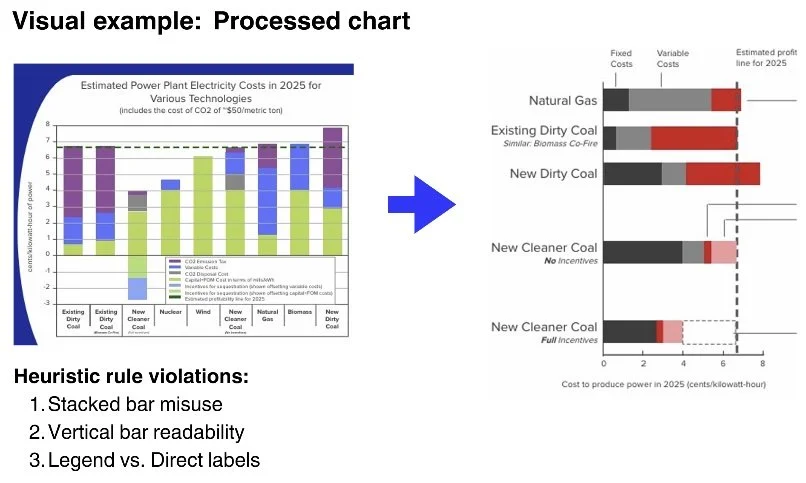
In this example, the system transformed a cluttered stacked bar chart into a clean horizontal comparison.
UI Prototype (built using Cursor)
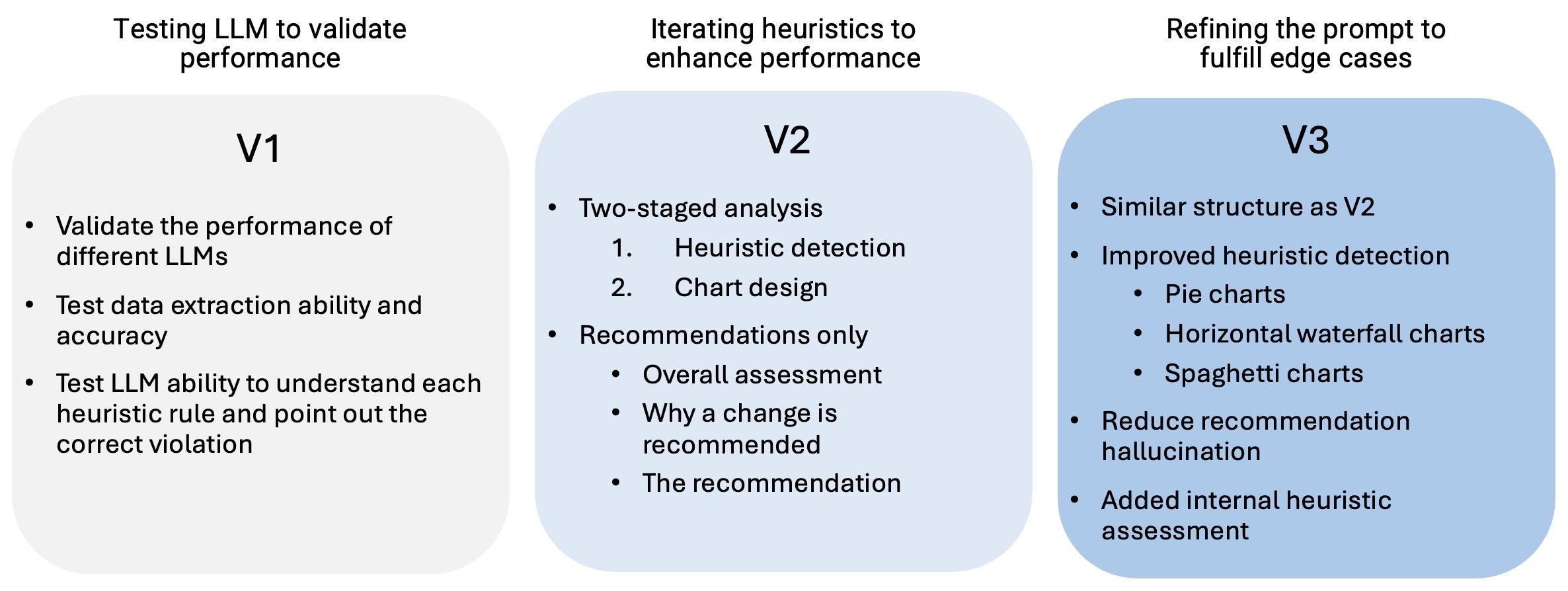
Prompt iteration journey
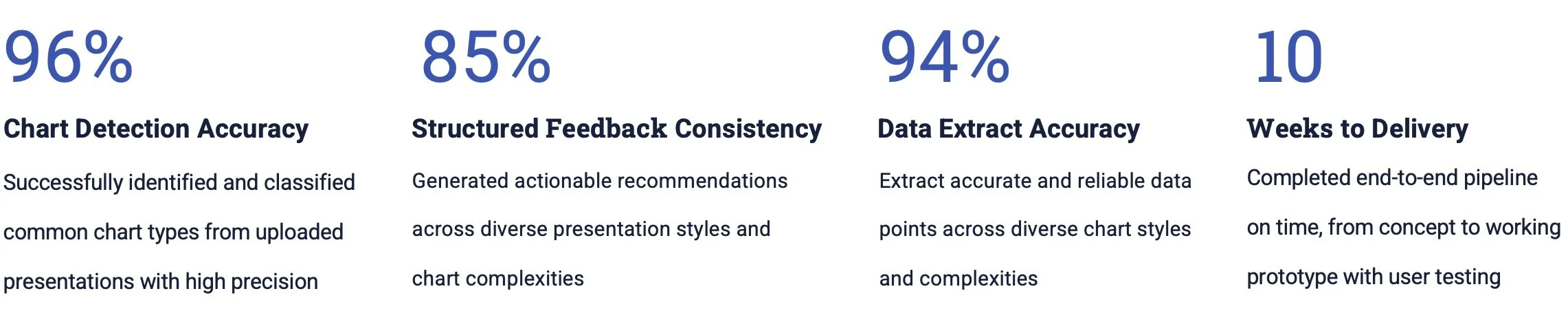
Results
The 10-week sprint delivered a working prototype that exceeded stakeholder expectations and demonstrated clear technical feasibility:
Learnings
Navigating Ambiguity: Building AI products requires strategic trade-offs. By adding design rule filters before LLM processing, we reduced variability and cut false positives by 40%.
Codifying Expertise: The project was a deep dive into turning qualitative "expert judgment" from the founder into measurable data logic, achieving 90% feedback accuracy.
Co-Creation: Innovative solutions aren't just about the tech; they're about co-creating understanding and value with the client through iterative prototyping.